
The finding: Of the 25 most-searched electric-vehicle questions in the United States, 15 are about charging and only 4 are about range. Yet between January and September 2026, US search interest in “ev range” rose 73% on the same months of 2025, against 7% for “ev charging stations”. In the United Kingdom, India and Canada, range searches also grew faster than charging-station searches. The common view that anxiety is moving from range to charging is not what the data show: charging still dominates the questions, but the growth is in range and in price.
Why this matters
Range anxiety is usually described as the fear of being stranded before the next charger. A recent integrative review of 52 papers argues that this definition is too narrow: the anxiety can be tied to a particular situation or be a lasting trait, and it has technical, psychological and rhetorical sides (Baden, 2025). A systematic review of drivers’ range anxiety likewise points to individual factors, such as experience and self-efficacy, and to interface features such as state-of-charge displays and charging-point maps (Rainieri, Buizza and Ghilardi, 2023). In other words, “range” and “charging” are not separate worries. We asked what drivers actually look for, in four English-language markets (United States, United Kingdom, India and Canada), and how that mix changed through 2026 in search interest, news and blog coverage and research papers. It is a description of public attention, not advice on buying or driving a vehicle.
Finding 1: Charging is what people ask about, and range is a small slice
The 25 most-searched EV questions in the US draw search volumes that run from 2,900 to 823,000 a month (Chart 1). Fifteen are about charging, six are about price, incentives or used cars, and four are about range. Range questions are all shopping questions: “longest range electric car” (8,100 a month), “longest range ev” (4,400), “best range electric car” (3,600) and “electric car range” (2,900). The named phrases for the worry itself are tiny: “ev range anxiety” is searched about 90 times a month in the US, and “charging anxiety” about 30.
Chart 1: The 25 most-searched EV questions in the US
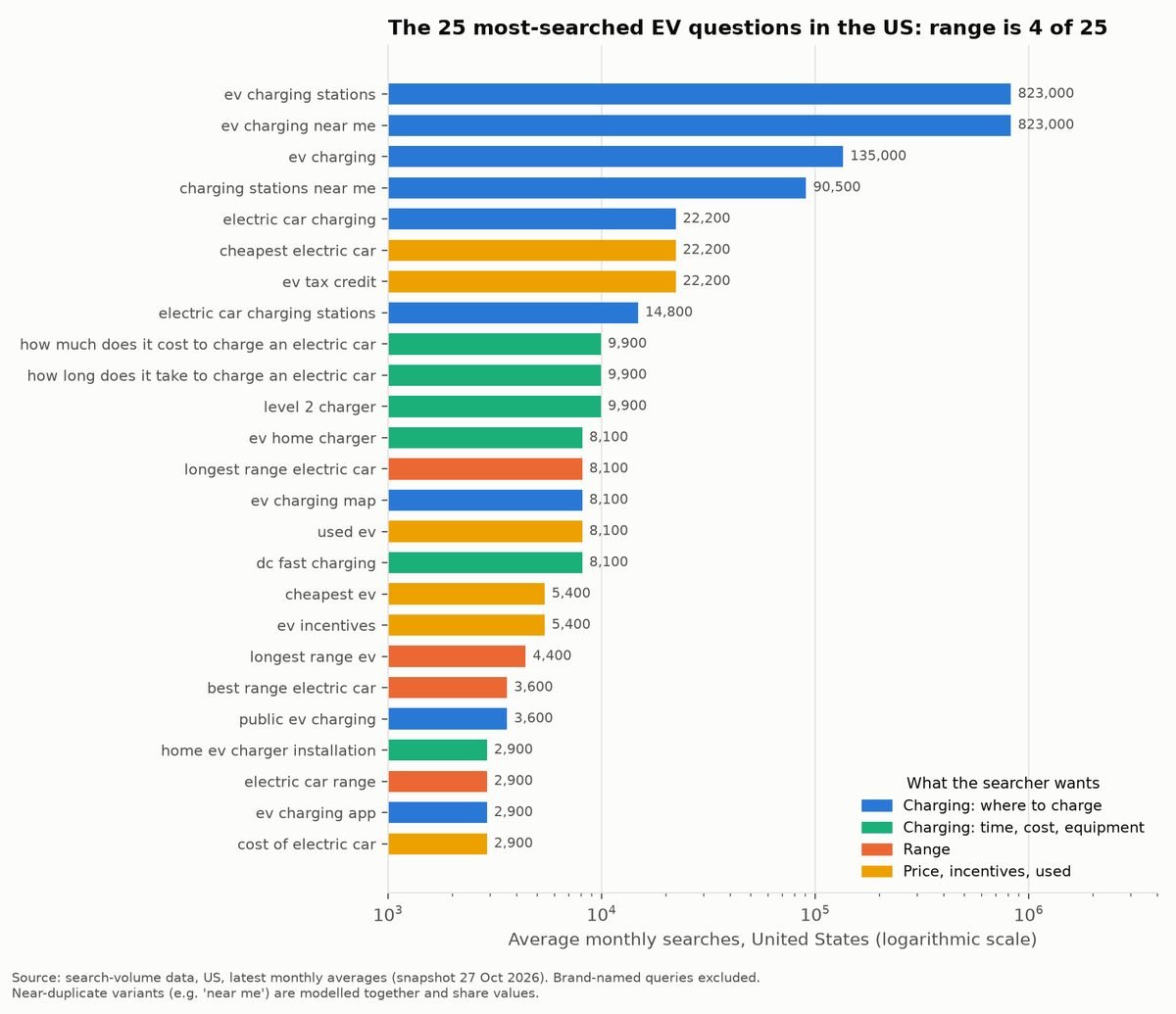
By volume, charging takes 95.9% of the top 25, but that total is dominated by four location queries (“ev charging stations”, “ev charging near me”, “ev charging” and “charging stations near me”) that are modelled together and overlap. Taking those four out, the remaining 21 questions split into charging 54%, price, incentives and used cars 36%, and range 10%. Either way, drivers are asking where, how fast and how much to charge, and what an EV costs, far more often than how far it goes.
| Query | US monthly searches | UK | India | Canada | Group |
|---|---|---|---|---|---|
| ev charging stations | 823,000 | 301,000 | 368,000 | 135,000 | Charging: where |
| ev charging | 135,000 | 74,000 | 18,100 | 18,100 | Charging: where |
| cheapest electric car | 22,200 | 12,100 | 4,400 | 1,600 | Price |
| ev tax credit | 22,200 | 140 | 590 | 260 | Price |
| how much does it cost to charge an electric car | 9,900 | 6,600 | 260 | 1,000 | Charging: time, cost |
| level 2 charger | 9,900 | 140 | 90 | 1,900 | Charging: equipment |
| longest range electric car | 8,100 | 6,600 | n/a | 720 | Range |
| ev home charger | 8,100 | 12,100 | 1,600 | 720 | Charging: equipment |
| electric car range | 2,900 | 1,600 | 1,300 | 210 | Range |
n/a = no figure returned. The full 25 queries are in the data table file. The markets differ: “ev tax credit” is a US question (22,200 a month against 140 in the UK), “ev home charger” is bigger in the UK (12,100) than in the US (8,100), and “electric car price” alone draws 33,100 searches a month in India.
Finding 2: Range searches are growing faster than charging searches
If anxiety were shifting from range to charging, charging-station searches should be gaining on range searches. They are not. Measured against each market’s own 2024 average, searches for “ev range” ended October 2026 at 131 in the US, 235 in the UK, 278 in India and 135 in Canada. “Ev charging stations” ended at 71, 95, 164 and 75 (Chart 2). The gap opened in 2025 and widened in 2026: between January and September 2026, “ev range” searches were up 73% (US), 101% (UK), 109% (India) and 70% (Canada) on the same months of 2025, against 7%, 69%, 57% and 31% for “ev charging stations”.
Chart 2: Range searches climbed faster than charging-station searches
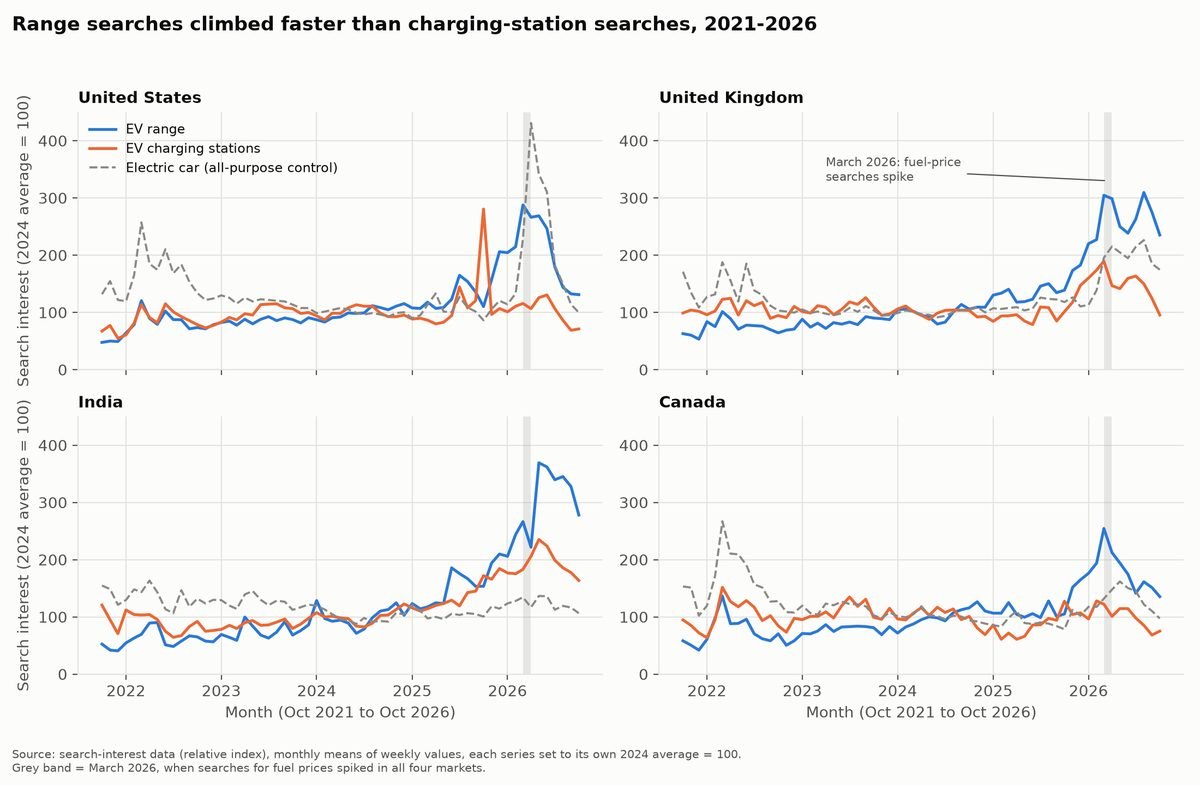
Two cautions. First, the rise coincides with a fuel-price shock: in March 2026 searches for fuel prices stood at 568 (US), 1,256 (UK), 454 (India) and 420 (Canada) against their 2024 averages, and “ev range” reached its high in the same month in the US and Canada. Searches for “electric car” in general also rose, so some of the lift is simply more people looking at EVs. The data cannot prove a link, and we do not claim a cause. Second, the lift has faded: by October 2026 “range anxiety” in the US had fallen from 927 at its June peak to 143, still above its 2024 level but far below the spring.
The phrase “range anxiety” itself behaves like a news-cycle word. In a five-phrase comparison, its share of US search interest went from 3% in 2022 to 15% in 2026 to date, and in Canada from 0% to 12%, while “charging anxiety” reached only 5% in the US and 2% in Canada (below 1% in the UK and India). The base is small, so these shares are best read as direction, not size.
Finding 3: The question mix is slowly leaning to cost and battery
Which of five core themes drivers search for is a steadier signal than any single phrase. Charging is still the largest share in all four markets, but it slipped between 2022 and 2026: from 50% to 48% in the US, 66% to 55% in the UK, 39% to 36% in India and 47% to 41% in Canada (Chart 3). Range held roughly level (16% to 14% in the US, 13% to 14% in the UK, 21% to 25% in India, 20% to 19% in Canada). Cost gained in the UK (10% to 14%), the US (15% to 17%) and Canada (13% to 17%), and battery gained in the UK (10% to 16%).
Chart 3: The question mix across four markets
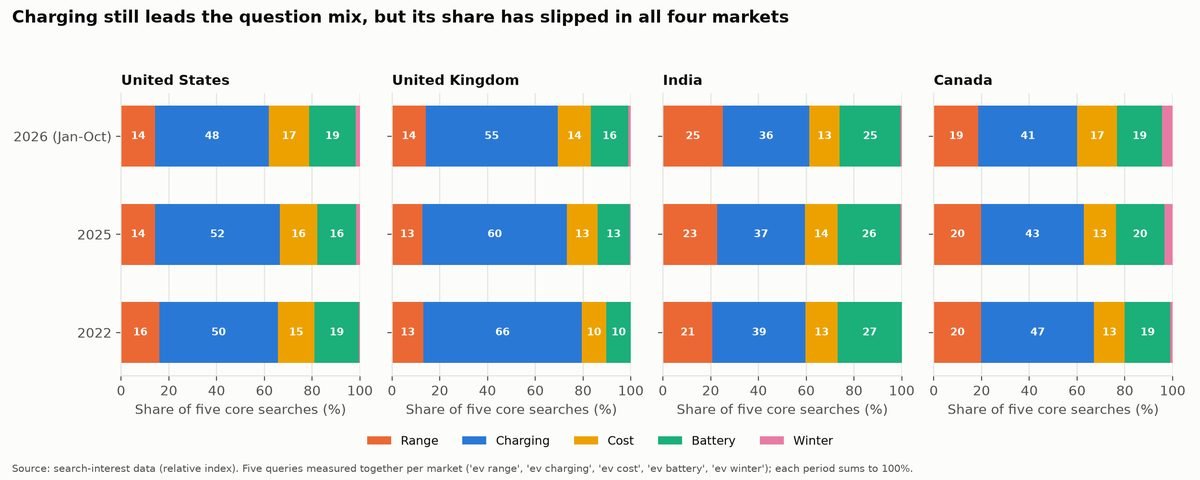
Cold weather barely registers. The five winter-range phrasings that returned data add up to about 110 searches a month in the US. “Ev winter” grew as a share of the five core searches, from 0.4% to 1.8% in the US and 0.9% to 4.3% in Canada, which suggests the question is real and still small. Lab work on cold-weather range loss shows why it could matter: in a study of two production electric cars on more than 125 trips around Munich, range fell by up to 31.9% because of cabin heating and by up to 21.7% because of limited regenerative braking, a combined drop of about half in the worst cold (Steinstraeter, Heinrich and Lienkamp, 2021). Our searches cannot say whether drivers worry about this and ask elsewhere, only that they rarely type it into a search box.
Finding 4: Stated attitudes point at charging confidence, not range
Survey evidence complements the searches. In a Pew Research Center survey of 8,638 US adults in May 2024, 56% were not too or not at all confident that the country will build enough infrastructure to support large numbers of EVs, and 72% said EVs need a bigger up-front investment than petrol vehicles (Pew Research Center, 2024a). Among those very or extremely confident in infrastructure, 58% would seriously consider an EV, against 16% of those who were not confident. Pew’s analysis of 10,329 adults found that 39% of Americans live within a mile of a public charger, and that attitudes to EVs did not differ much by how often people take long trips (Pew Research Center, 2024b). By March 2026, 32% said they would seriously consider an EV, down from 42% in 2022 (Pew Research Center, 2026).
So the anxiety that opinion polls capture is mostly about the network and the price, while the anxiety that has grown in searches is about range. They are compatible: confidence in infrastructure shapes whether someone considers an EV, and range is what a prospective owner then checks when comparing models. The United Kingdom shows the supply side: its official statistics count 121,171 public chargers at 1 July 2026, including 28,887 rated rapid or above (Department for Transport, 2026).
Finding 5: News coverage moved to price, not to range or charging
Chart 4: ‘Range anxiety’ in searches, news and research
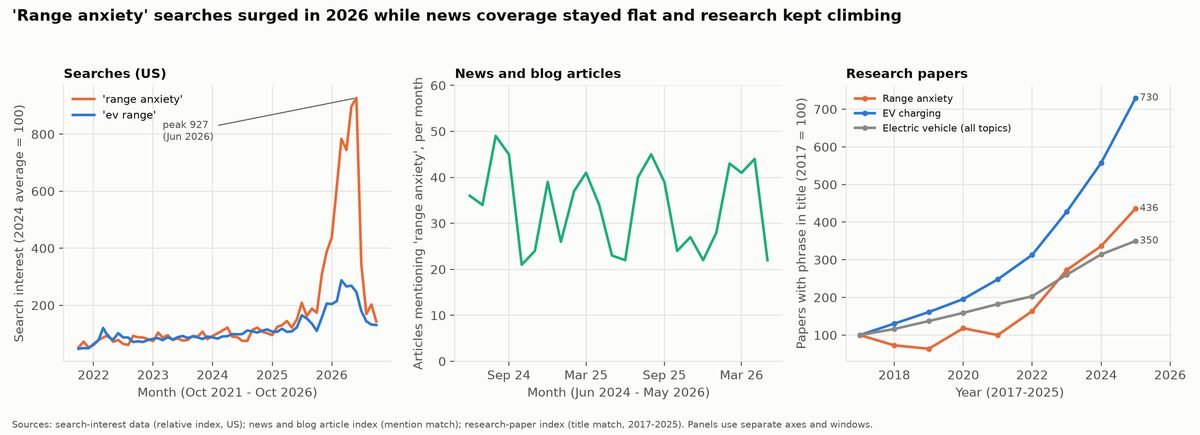
News and blog coverage of “range anxiety” is thin and flat. Our archive holds 806 articles that mention it between June 2024 and May 2026, 409 in the first twelve months and 397 in the second. Within the 259,758 articles about electric vehicles, 593 carry the phrase, about 0.2%. That coverage is unusually positive: 87% of tone-labelled articles are positive (0.15 negative per positive article, against 0.30 for electric-vehicle news as a whole), which fits articles presenting charging speed, battery or range improvements as solutions. “Charging anxiety” appears in only 37 articles. Meanwhile research keeps growing: papers with “range anxiety” in the title rose from 11 in 2017 to 48 in 2025, papers on EV charging from 643 to 4,694 (7.3 times) and all electric-vehicle papers from 3,669 to 12,847 (3.5 times). Research attention has moved faster to charging than to range, even as searches moved the other way.
On the map, news that mentions “range anxiety” is placed mostly in the United States (25.4% of the articles that could be placed), India (13.6%), China (9.7%), Japan (9.0%) and the United Kingdom (6.7%). Coverage of EV charging in general is placed in the United States (27.8%), the United Kingdom (12.0%) and India (11.6%).
What the news is talking about: rising and falling themes
When journalists and bloggers write about electric vehicles, which subjects gained or lost share? We compared two full 12-month windows: 1 June 2024 to 31 May 2025 (134,002 articles) and 1 June 2025 to 31 May 2026 (125,756 articles, 6% fewer). The later window stops at May 2026 because news ingestion thins after that month, and the earlier window is the same length so the comparison is fair. For each theme we measured the share of all electric-vehicle articles that also carry the theme’s word in the lede or tags (Chart 5).
Chart 5: Themes that gained and lost share of electric-vehicle news coverage
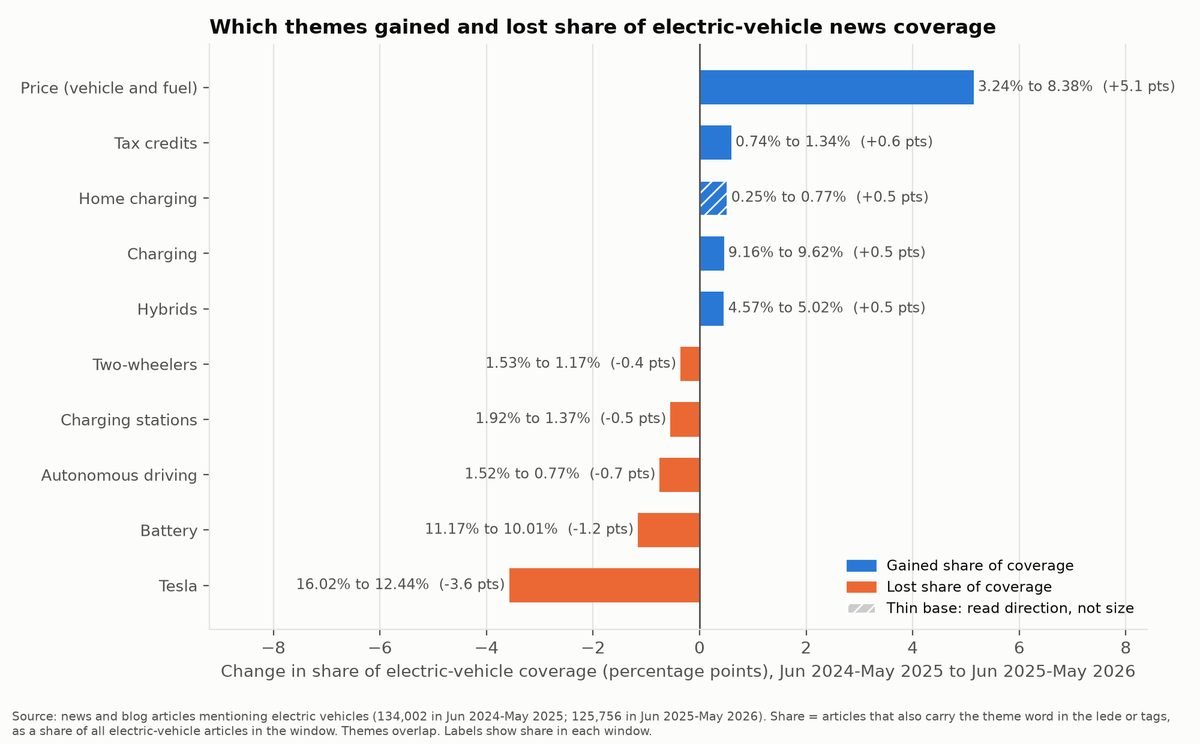
| Theme | What counts as the theme | Share, Jun 2024-May 2025 | Share, Jun 2025-May 2026 | Change |
|---|---|---|---|---|
| Price | EV articles that mention price or prices in the lede or tags (vehicle and fuel) | 3.24% | 8.38% | +5.1 pts |
| Tax credits | …mention tax credit | 0.74% | 1.34% | +0.6 pts |
| Home charging | …mention home charging (thin base) | 0.25% | 0.77% | +0.5 pts |
| Charging | …mention charging | 9.16% | 9.62% | +0.5 pts |
| Hybrids | …mention hybrid | 4.57% | 5.02% | +0.5 pts |
| Two-wheelers | …mention two-wheeler | 1.53% | 1.17% | -0.4 pts |
| Charging stations | …mention charging stations | 1.92% | 1.37% | -0.5 pts |
| Autonomous driving | …mention autonomous | 1.52% | 0.77% | -0.7 pts |
| Battery | …mention battery | 11.17% | 10.01% | -1.2 pts |
| Tesla | …mention the carmaker by name | 16.02% | 12.44% | -3.6 pts |
Only one change is large: price more than doubled its share of EV coverage, from 3.2% to 8.4%, which fits both the fuel-price spike and the search evidence that cost questions are gaining. Tax credits, home charging and hybrids rose modestly. Range barely moved (3.56% to 3.49%), charging held steady (9.2% to 9.6%), and the named “charging stations” phrase lost share while a second method that counts curated labels saw “ev charging station network expansion” edge up (3.4% to 3.6% of labelled articles), so the charging-station fall is not a firm signal. Cold weather is almost absent: 163 articles, 0.06% of coverage in both windows. The fallers are mostly one carmaker (Tesla, -3.6 points), battery and driverless-car stories rather than the range-or-charging debate.
How far to trust it. Themes overlap, so shares do not add up to 100%. Home charging starts from a small base (338 articles in the first window), so its direction is clearer than its size. “Price” is a broad word match and includes fuel prices and price cuts. Two months with unusually large volumes (September 2025 and February 2026) could distort shares; removing both leaves the direction of all ten themes unchanged. A fifth riser, tariffs (5.75% to 6.43%), reversed direction in the same test, so we left it out. Curated labels agree on direction for incentives (2.7% to 3.2% of labelled articles) and hybrid tax-credit policy (1.3% to 1.8%).
Finding 6: Where range takes the larger share of EV searches
Map: range as a share of range and charging searches, by country
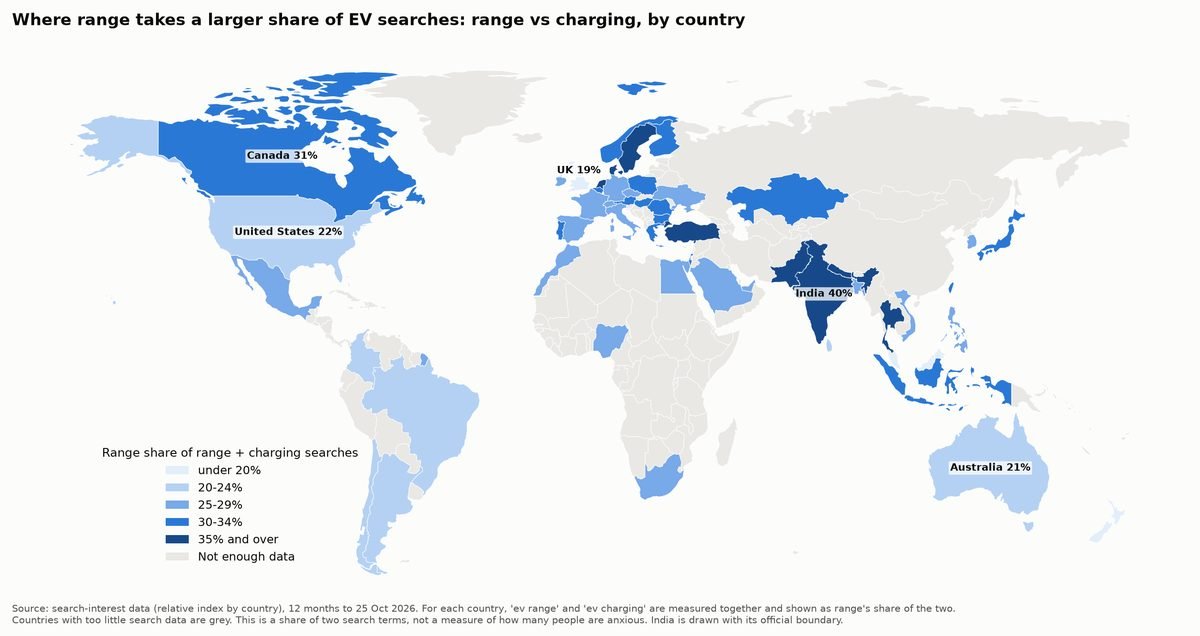
The map compares, for each country, how the two searches “ev range” and “ev charging” divide between them over the last 12 months. India has the highest range share of the 56 countries and territories with enough data (40% of the two), followed by Pakistan (39%), Denmark (38%), Nepal (37%) and Türkiye (37%). Singapore and Hong Kong (17%), New Zealand (18%), the United Kingdom (19%) and Malaysia (19%) have the lowest. The United States is at 22% and Canada at 31%. This is a ratio of two search terms, not a count of anxious people, and search habits differ by country, so we do not draw conclusions about infrastructure or climate from it.
What it means
Charging is where EV questions start, but it is not where they are growing. Range searches rose faster than charging-station searches in all four markets, cost and price gained in news and in the question mix, and cold weather is a small but growing slice. For the year ahead, the readable signal is that range is being checked more often as EVs become a mainstream comparison, and that fuel and vehicle prices can move attention quickly. Whether the spring 2026 surge fades or returns is open: US range-anxiety interest had fallen back to 143 by October.
Methodology and limitations
Search interest is a relative index, so percentages describe direction, not people. We used 5-year weekly series for the US, UK, India and Canada, with each series compared to its own 2024 average. Individual low-volume phrases are rounded to small integers and are noisy, so we used them for shares and direction only. Search volumes are modelled monthly averages (snapshot 27 October 2026); several near-duplicate queries share the same value, and some queries returned no figure. Brand-named queries were excluded from the top 25 (ties at 2,900 were broken by UK volume). News and blog counts are mention matches over June 2024 to May 2026, and the theme comparison uses two equal 12-month windows ending 31 May 2026. Geography reflects the place an article is about, available for 56.4% of “range anxiety” articles. Paper counts match titles only and are not normalised for corpus growth. Not covered: community discussions and customer reviews from real owners, because no suitable sources were available to us, so this study cannot say how owners’ experience differs from prospective buyers’ concern; and a US state map, which is replaced by the world map. Full notes are in the methodology file.
Data and analysis. The news, search and research-paper analysis in this article was run with Fliar Prism (Fliar Business Intelligence, 2026a), and the research tools it uses are published as the open-source Prism MCP (Fliar Business Intelligence, 2026b).
References
Baden, K.B. (2025) ‘More than just miles: range anxiety unplugged’, Transportation Research Part A: Policy and Practice, 200, 104661. https://doi.org/10.1016/j.tra.2025.104661
Department for Transport (2026) Public electric vehicle charging infrastructure statistics: 1 July 2026. GOV.UK. https://www.gov.uk/government/statistics/electric-vehicle-charging-infrastructure-statistics-1-july-2026/public-electric-vehicle-charging-infrastructure-statistics-1-july-2026 (Accessed: 27 October 2026).
Fliar Business Intelligence (2026a) Fliar Prism: news, search and research-paper analysis [Data and analysis platform]. (Accessed: 27 October 2026).
Fliar Business Intelligence (2026b) Prism MCP: open-source research tools [Software]. GitHub. (Accessed: 27 October 2026).
Pew Research Center (2024a) About 3 in 10 Americans would seriously consider buying an electric vehicle, 27 June. https://www.pewresearch.org/short-reads/2024/06/27/about-3-in-10-americans-would-seriously-consider-buying-an-electric-vehicle/ (Accessed: 27 October 2026).
Pew Research Center (2024b) Electric vehicle charging infrastructure in the U.S., 23 May. https://www.pewresearch.org/data-labs/2024/05/23/electric-vehicle-charging-infrastructure-in-the-u-s (Accessed: 27 October 2026).
Pew Research Center (2026) Are Americans interested in EVs and hybrids as their next car in 2026?, 3 April. https://www.pewresearch.org/science/2026/04/03/how-appealing-are-electric-vehicles-and-hybrids-to-americans/ (Accessed: 27 October 2026).
Rainieri, G., Buizza, C. and Ghilardi, A. (2023) ‘The psychological, human factors and socio-technical contribution: a systematic review towards range anxiety of battery electric vehicles’ drivers’, Transportation Research Part F: Traffic Psychology and Behaviour, 99, pp. 52-70. https://doi.org/10.1016/j.trf.2023.10.001
Steinstraeter, M., Heinrich, T. and Lienkamp, M. (2021) ‘Effect of low temperature on electric vehicle range’, World Electric Vehicle Journal, 12(3), 115. Technical University of Munich research portal. https://portal.fis.tum.de/en/publications/effect-of-low-temperature-on-electric-vehicle-range/ (Accessed: 27 October 2026).
Learn More
If you found this research useful, you may also like:
- Cheapest New Cars 2026: Prices, Value Picks and What to Know Before You Buy
- Advanced Driver Assistance Systems in 2026: 7 Safety Features Every Car Buyer Should Know
- The Hidden Factors That Make One EV Cheaper to Charge Than Another

Content Writer at AutosAdvise. Thomas Mills covers new car reviews, prices, specifications, and buying guides. He aims to make every article clear, practical, and easy to understand — so readers can compare models with confidence and choose the right car for their needs.